Overview
A Service Level Agreement (SLA) is a documented agreement between a service provider and a client that identifies the required services as well as the customer’s expected level of service. Between the service provider and the service user, certain aspects of the service like the quality, availability, responsibilities, etc are agreed upon. The most common aspect of an SLA is that, as agreed in the contract, the services should be given to the client. For a service provider, the SLA is considered an important document and is usually one of two foundational agreements it has with the clients.
At IP and Legal Filing (IPLF), we know the implications of an SLA agreement and assist in preparing agreements to assess efficiently the performance of services from the point of view of the consumer effectively and make them clearly understandable from the broader business perspective.
What Is The Process?
- These arrangements are unilateral. The B2C (Business to Consumers) agreements are standard and are not negotiated. They are signed between the service providers and the consumers.
- When an agreement is being put in place, the service provider must provide the terms of the service in detail, and the experts shall encapsulate it in the best and most universal way feasible to satisfy the needs of a wide range of consumers and provide for a well-drawn uniform agreement.
Details Required
- Specifics of Services Provided
- Conditions of Service Availability.
- Time Window for each level of service responsibilities
- Escalation Procedures
- and Cost/Service Trade-offs
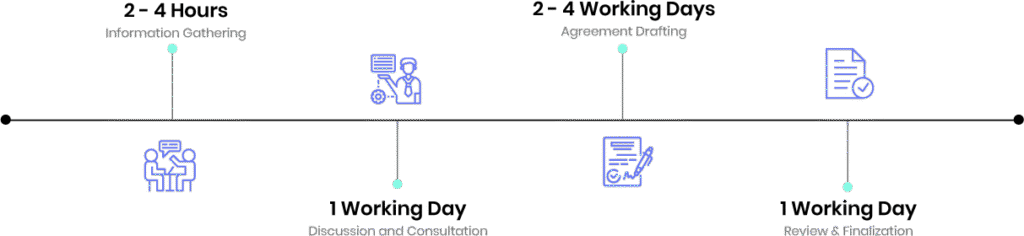
Timeline
Disclaimer: ASK AD-WISE is a privately operated consulting firm and is not affiliated with any government department. The form on this website is intended to collect client details to provide customized support and consultancy. All services are chargeable, and fees collected are for professional assistance. We may outsource certain cases as needed. By using this site, you agree to these terms.